Showing posts with label Danny. Show all posts

Friday, May 28, 2010

A welcome rest at the end of the week

It’s been a good week. Lots of work. I’m glad that it’s the end of the week and we have a day of rest – a welcome respite every week. Normally, I don’t like to post without photos, but I decided to go ahead tonight, mainly because I didn’t take any pictures this week.

On Monday, my friend Jon came over (he’s coming over on Mondays and Wednesdays to work with me), and we dug footers for the porch and kitchen on the new house. We also planed some boards that will be used for the upstairs subfloor.

On Tuesday, the children and I worked in the garden. The potatoes were really needing weeded. The children worked on weeding Monday and Tuesday. Then, I tilled between the rows. The potatoes in this particular plot haven’t done as well as I would like. I think the wet weather after they were planted didn’t help. In the morning on Tuesday, I also bought 100 80-pound bags of concrete mix in order to be ready for pouring the footers on Wednesday.

Wednesday morning was the scheduled delivery for our coop order. Thankfully, Danny offered to get it for me. I had a few things to do to be ready for when Jon arrived. Once he got here, we began mixing and pouring concrete. Thankfully, I bought an electric powered concrete mixer from Lowes a few weeks ago when we started working on the cistern again. It worked great powered by my Yamaha generator (which is so quiet you couldn’t hear it over the noise of the mixer).

We started with the footer for the kitchen. I ran the mixer while Jon dumped the concrete and tamped it down. It took 54 bags to finish it, mixing two at a time. We used three bags of concrete for each of the porch footers (one for below each post). The mixer was just able to hold three bags worth, and we were able to position the mixer for each one so that we could dump straight into the hole. It all went very smoothly. We mixed 98 bags of concrete and got the job done. I was a little tired at the end of the day!

On Thursday, I cut some wood for the cookstove, and then the children and I worked in the garden. We planted some sweet corn, more green beans, zucchini squash, and cantaloupe and set out another 100 sweet potato slips (we now have 300 sweet potato plants growing). I also bush hogged where the cows have grazed during the last two weeks, mixed some manure with wet hay, adding to one of the compost piles, and tilled the field for growing beans and squash. The children and I ended the day with a swim in the pond, the same as we did on Monday and Tuesday.

Today, I replanted the corn field because it looks like only about 1/3 of the corn we planted two weeks ago came up. I don’t know why it didn’t germinate well. It may have been too wet. I do know that crows ate a good bit of it right out of the ground. I used the garden planter to replant today. It took a bit of work since I didn’t work the ground first (I didn’t want to disturb the corn plants already up). Hopefully, what I planted today will germinate and grow well with little interference by pesky crows.

I also planted our dried bean seeds. The rows in this field are 80 feet long (give or take 15 feet). I planted 4 rows of small kidney beans, 12 rows of pinto beans, 12 rows of red beans, and 12 rows of horticulture beans. I also planted several kinds of winter squash, some pumpkins, okra, and cantaloupe. Then, this afternoon, I went to town and bought some concrete blocks and mortar mix to be prepared for more work on the new house on Monday.

Oh, I also completed some class work (I’m teaching a six-week section during the summer session) in the mornings before everyone else got up. There are a few other things I did during the week, but the ones I’ve mentioned are the major ones. It was a good week with lots of things accomplished, and I’m glad that it’s Sabbath now!

Saturday, January 30, 2010

Five and a half inches of snow

Snow in a cedar treeThe children have been anxiously anticipating the arrival of the winter storm forecast for our area. Uncle Danny, our local weather aficionado/junkie, contributed to their excitement by giving them regular updates on the expected amount of snow and when it would start. Yesterday morning, because the storm had slowed down Who left the tricycle outside?and delayed its deliverance of white matter, Malchiah rushed outside when he saw Uncle Danny emerge from his house and very seriously asked him, “Uncle Danny, why isn’t it snowing?” 

The snow finally began yesterday about mid-afternoon. Most of what we’ve gotten so far fell overnight. So, the children were excited and noisy when soon after they woke up this morning. They couldn’t wait to get out in Heading down the hill to do choresthe snow with visions of great sledding and fun bouncing around in their heads.

Once we got things done in the house, the three older ones and I headed out to do our chores. There were many exclamations of delight about the snow and awe for it’s depth – 5.5 inches. We haven’t had this much snow at one time here the whole time we’ve lived here.Snow 'down the hill'

We tramped down the hill, and I took a few photos. Malchiah soon discovered the joy that snow packed in one’s boots can impart. He wasn’t too happy about it. Once we got to the barn, he tried to get the snow out, but he was quite distraught with the cold that was being imparted to his leg and foot.Another view 'down the hill'

After milking Tilly, Ramiah decided that his feet were cold, too, but not because of snow in his boots. The temperature was almost 20 degrees. So, the two boys marched back up the hill to the house to warm up. Jessica and I finished our chores before we went back to the house.

The forecast is calling for more snow this morning. Sometime today, I’ll go out with the younguns to enjoy some sledding. We’ll have fun.

Tuesday, January 5, 2010

Where’s the beef?

On May 14, 2007, our Guernsey, Josey, gave birth to Chucky Joe, a little bull calf. It’s been something watching him grow during the last 19.5 months. I banded him when he was a couple of months old (he was just about too big at the time) in order to make a steer out of him. We’ve raised him for beef. Sometime in the next two weeks, we’ll butcher him. I know that to some that may sound like a harsh thing, but that’s what he was created for – to become beef (and to provide the materials to make two powder horns).

Chucky has lived a good life. He’s had plenty of grass and hay to eat and good clean water to drink. He’s gotten to be with or near his mother his whole life. In fact, he still nurses. Chucky JoeShe never kicked him off. It’s something to see a 900+ pound steer nursing. Josey is just too patient and kind to wean him. I tried to wean him, but it just didn’t work because Josey wouldn’t help. Even those weaner things you put on a calf’s nose didn’t work. He found a way to work around it. I even kept the two of them separate for two and a half months, but when they were together again, it was like they’d never been apart. Finally, I gave up.

If we put off killing Chucky for beef until next winter, I’m sure we’d get more out of it. He’s got the frame to grow quite a bit more, but, I don’t want to keep feeding him for another year. So, his time is coming soon. Dad, Danny, and I will do the job. Mom and Anne will help with the processing, too. We got fewer deer this year than usual, but with the addition of the beef from Chucky, we’ll have enough meat for the coming year.

We don’t buy and eat conventionally raised and processed meat from the store. The way animals are treated and raised and what they are fed and injected with in order to provide that unnaturally-colored meat in the supermarket is horrible. I don’t want to consume it, let alone support the industry and its practices.

I want to know how my meat is raised. I want the animal from which it comes to live a good live, eating good food, and to not be filled with antibiotics and hormones. A cow is not meant to eat a diet of corn and corn products; it is a grass eater. Chucky has eaten grass and hay his whole life; he has lived naturally. The meat we get from him will be healthful and will have been gotten in an ethical, humane fashion. And, apart from some labor and a little fuel and string for making bales of hay to feed him, it’s free meat. In my book, that’s good.

Monday, June 22, 2009

Blueberry propagation

We have a few blueberry bushes that we’ve planted in the previous three years. There’s a local blueberry farm that sells berries and plants. They actually sell thousands of plants every year that get shipped all over the world. Last year Dad, Danny, and I picked berries for a couple of days for them. We took payment in blueberries rather than in cash.


Our bushes are small yet, and there aren’t very many. We’d like to be able to grow more of our own. We could buy plants from Bluegrass Blueberries, or we could start our own to set out. Danny has been picking berries again this year, and he asked a lot of questions about blueberry propagation. Apparently, it is quite easy to new plants going.

For our propagation endeavor, I set an old tractor rim that was in my barn out near the garden and filled it with peat moss. Peat moss can be bought from places that sell plants and gardening supplies. Another alternative that works well is saw dust. I believe that rablueberry cuttingw saw dust from a saw mill rather than from a cabinet shop would be better. I didn’t have any saw dust other than from cedar logs available, and it has oils in it that makes it less than ideal.

Once filling the rim with peat moss, I began to add water in order to soak it well. It took a lot of water. We needed it to be well saturated. I think we added enough water to make it a peat bog.

Once the propagation area was ready, Danny and I went to get some blueberry clippings. We cut new growth off of the plants. Some cuttings were only three or four inches long, but others were over a foot. blueberry cuttingsIt just depended on the plant and the kind of growth it had put out.

We took the cuttings to the tire rim. Danny then began to cut the longer ones into shorter lengths. He cut them so that they each had at least three leaf nodes. We removed all but the top one or two leaves and then stuck the cuttings into the wet peat moss where they’ll stay for the next year or so. I’m keeping them well watered so that the peat moss stays moist.


It was cloudy and rainy when we put them out and for the next couple of days which is good because you don’t want cuttings with shade cloththem to have too much sunshine which can dry them out and kill them. Because we expected to see the sun again before too many days passed, I put a shade above the cuttings. Normally, a 50% shade cloth is used. I used what we had available, and I don’t know what it’s rated at. I set it up a few feet above the cuttings so that I can get under it to water them. At that height, they also get some morning and some afternoon sun.

We put 70 cuttings into the peat moss. We hope to have at least 50 plants survive until next fall (2010). We’ll have prepared a place for them and will set them out at that time. They do better when set out during the fall as opposed to being set out in the spring.

Thursday, January 22, 2009

Firewood and another video

Dad and I cut a truck load of firewood this morning. He posted a photo essay about our wood-cutting activity. We used the 1979 F250, and it worked fine. It’s easier backing it into position than a 16 foot trailer. We dumped the firewood near Danny’s newly constructed wood shed. It seemed like a good thing to do. He “complained” about the work we left for him, but I think he was able to get it stacked inside. He also said that he would be willing to accept some more if we need to get rid of it.

Since yesterday evening, after putting together a video for the first time, I’ve been thinking about making some more videos. Someone asked for some with your younguns. That one will have to wait until I have material together. When talking about using Windows Movie Maker to put together the 1950 John Deere MT video, Mom mentioned the possibility of using it to put together some photos of our timber frame raising. She and Dad took a series of photos at different stages of the raising that flow together to create an animation. So, this evening I put another video together using photos. I think it turned out pretty good.

Tuesday, December 30, 2008

Homestead objectives (part II)

I made a list of some of our main objectives thinking that I would write one post describing them. Then, I started and determined that such a post would be quite long, longer than I had thought it would be. So, I’ve broken it down into individual posts focusing on the individual objectives. The first one I covered was to grow and harvest good food.


The second objective I’ll discuss is to grow together as a family.

Homesteading provides opportunities for us to be together and to work together that would not otherwise be possible. I’m very blessed in the job that I have because Sabbath breakfastit allows me to work from home. It’s also not full-time work. The income it provides is less than many families spend just for food each month, but it allows us to be together. We have made choices about how weChore helpers live, and we appreciate the advantages that come with it. Sure, it would be nice to still have the income I had before we moved here, to still live in our big, red-brick house, but I would be gone much of each day and several evenings every week. I wouldn’t be around for us to eat three meals together as a family like we do now. I wouldn’t be there every night to help get the children ready and into bed and to kiss them goodnight. We wouldn’t be together as we are now. Our children are Malchiah with handtruckgrowing up with their daddy as an every day part of their lives. In fact, Malchiah and Naomi have always had it so.

We homeschool our children. There are too many influences in the public schools that we do not want them exposed to. Our children do not watch TV or play video games. They don’t go out to eat or to movies. They don’t do many of the things that most of society thinks of as “normal.” They aren’t deprived, though. They have 57 acres of woods and fields to run around in. They have great imaginations and are able to use them. Naomi reading at Mammaw's HouseThey have responsibilities and jobs and are learning the value of working. They have been around and know about the process of live, its beginnings and endings. They are developing a healthy respect for and understanding of the purpose of the animals God has created. Reading togetherThey are learning about proper stewardship for the things God gives us responsibility for. 

Ideally, schooling is a natural, normal part of life. We try to make that so. We also use some specific curricular tools and have “lesson” time for the children. They’ve been read to since they were just wee little things, developing a love of reading at an early age.

Our children are wonderful blessings, and God has given us a great responsibility in raising them properly. I wish I could say that we do it well. I know we don’t do it as well as we should. But, I can’t imagine the additional challenges that we would face in this task if we lived in different circumstances. When I was young, my family was financially poor, but we were rich in many other ways. We worked hard raising, harvesting, and preservingRamiah washing dishes food. I didn’t always appreciate the work when I was young, but I do now when I look back upon what I learned through it. I want my children to learn some of the same lessons and to not be selfish, in-debt consumers.

We have extended family here. My parents living next door on the farm is a wonderful thing. It seems so uncommon to find extended families in our culture and society. Yet, that is the model in the scriptures and in many cultures. There is a strength and are great blessings in having an extended family. Our children are being blessed in ways they don’t realize yet just by having their Mammaw and Pappaw  and Uncle Danny living here with them. Jessica doing lessonsIt’s also something that benefits my parents and Danny. I wish I could’ve grown up with my grandparents in the same way. There is so much more I could’ve learned from them.

I think that every homesteading adventure is unique, because each individual or family interprets and creates it in the ways that make sense to them. We thank God all the time for the opportunity we have to live here, to be together as a family. The are long-term benefits that we haven’t even imagine. Working and playing together, eating meals together, just being together, is incredibly important to us, and we are grateful that it is so.

Sunday, December 28, 2008

Homestead objectives (part I)

New Kentucky Homestead blog is only a little more than two weeks old. There is still a lot of information I would like to share in order to provide a background for understanding some of our activities and pursuits. I imagine that doing so will be an ongoing process; this is a dynamic enterprise. Hopefully, I will be able to continue posting regularly. My goal is five times a week with photos accompanying the posts.

So, today, I thought it might be beneficial to begin to describe some of our objectives here on our homestead, why we are here and what we intend to be doing.

The first objective (the only one for today) is to grow and harvest good food.

There are several ways in which we seek to meet this objective. The first one is with our garden. Most of the tillable land on our homestead has been used for growing tobacco in the past. Tobacco is a heavy feeder, and the growing of it in this area involves the use of chemical fertilizers, pesticides, and herbicides to some degree. We don’t know what chemicals were used on our ground before we moved here, although neighbors have told me that the weeds in the fields the summer prior to our move here outgrew the tobacco. GardenThe man growing on the property didn’t live here and didn’t spend the necessary time and money on the crop to keep the weeds under control. This is probably a good thing because it means he didn’t spray them as much as he might have otherwise.

We selected one of these tobacco patches as our main garden area. It measures approximately 300 feet by 80 feet and slopes slightly toward the south, along which side runs a small creek branch. There is a drive to other fields and areas between the garden and the creek branch. Across the branch our small ridge rises, and trees grow along it. These trees cast some early morning shade on the lower side of the garden.

As we’ve been using this area for our garden, the soil has improved. We’ve added compost, manure, and mulch in different quantities at various times and have also incorporated some green manures. Overall, the soil still needs amended, especially on the upper side where it has a higher percentage of clay.

The main garden crops we grow are tomatoes, potatoes (white and sweet), beans, onions, greens, okra, squash, cucumbers, peppers, and some herbs. produce 010There are other things and also several different varieties of each thing. We grow non-hybrids from which we are able to save seed as much as possible. For instance, this year we grew the following types of tomatoes: Amish Paste, Heidi (paste), Roma, Brandywine, Rutgers, Oregon Spring, Jubilee, and Marglobe. We saved seeds to start this coming spring from most of these and a couple of others that were given to us. I also would like to try some new varieties from Sand Hill Preservation Center (you should check them out if you’re unfamiliar with them – they are preserving so many different varieties of plants).
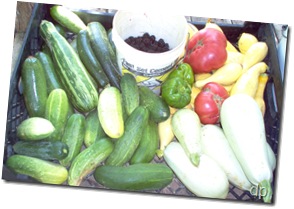
We planted 100 pounds of Kennebec seed potatoes last year. Fifty pounds we planted in April and fifty pounds in July. Sweet Potato Harvest 002The later crop did not produce as well as the early one. We planted the later one hoping that they would keep better because they were harvested later (the ones planted in  April were harvested in July). However, both crops seem to be keeping equally well. So, we’ll probably plant them mostly in the spring, hoping for a bigger harvest. After digging them this last summer, they spent about two and a half months spread out in the barn. This was probably the coolest place to keep them, and they seemed quite happy. They are now living in “the bus.” The bus is the storm shelter the previous owner built by burying the back end of a school bus into the hillside. We’re using it as a root cellar.

Besides green beans, we also grew Pinto, White Northern, and Horticulture beans this last summer. We’ve experienced difficulty growing dried beans in the past because they would begin to mold and/or sprout if left on the plants in the garden. Probably because of the humidity we have. This year when the beans were mature and had started to dry, I pulled up the plants and tied them into bundles, one bundle on each end of a short length of string. I hung these over four foot long tobacco sticks and suspended the sticks on some of the tier poles in the barn. Our barn is an old tobacco barn – it’s purpose was for holding tobacco to dry. This method worked very well, and we hope to grow more dried beans this coming year. The previous summer, we grew Horticulture beans also, but we picked them when they were mature but not dry, shelled them, and then canned them. Drying them in the barn and then threshing out the beans seems like less work than shelling the beans, plus, storing them dried will require less energy and processing time.

There is more to describe about our gardening, but I think I’ll save that for later. As we work on the process this spring and summer, it will make good sense to discuss it. Of course, time will be more limited then than now, but hopefully, I’ll be able to post enough detail to my blog.

There are other means by which we seek to grow and harvest good food. We also raise some grains, although this is an area still in development. I’ve already posted about growing corn in the previous post. Wheat in shocksAnother grain we have grown in the past and are trying to grow again this year is wheat. I planted about an acre of wheat in the fall of 2005. We harvested it in the summer of 2006 and put the shocks in the barn. I wanted to thresh it later in the year, but the mice had ruined it for human consumption by then. So, I fed it to the goats and turkeys. They loved it, and I didn’t have to thresh it for them.

At the beginning of October this year, I worked up an area, about 1/2 acre, and seeded 100 pounds of hard, white winter wheat. I’d like to acquire a small grain drill for seeding it because my hand-cranked broadcast seeder doesn’t produce a consistent stand. We’ll see how it does this summer, and if it does well, we will try not to wait too long before threshing it. I did try some spring wheat, seeding it last spring. It did not do well at all, and we got nothing out of it. I would like to try some hull-less oats, too. I need to find some seed for that.

We set out several small fruit trees about three years ago. Some have died, and some are doing okay. We had our 17 year locusts this last year. These cicadas bore into small diameter branches to lay their eggs, and they seemed to find our young apple trees to their liking. They were pruned quite severely by these noisy pests, but I think they’ll survive. However, we have so many cedar trees around that I’m not sure how well apple trees will do here because of cedar apple rust.

We can grow blueberries quite well in our climate. Our soil is generally acidic enough for them, too.  We have a few plants that are now old enough that we should get several berries from this coming summer. We pick quite a few gallons of wild blackberries in July each year. This last year I picked over 20 gallons of them. The biggest problem with picking wild blackberries, apart from the scratches the briars so generously endow, are chiggers. I had over 50 on each leg after one picking last summer. I use a citronella-based bug spray usually that helps a great deal, but I forgot to put it on that time.

Another source of good food is animals which we raise. We’ve had chickens for most of the time we’ve lived here, but this last summer we sold all of the. Feed prices were going up and the chickens did not recognize a fence as a barrier. They went over it or through it and scratched all over the neighborhood. This was actually a good thing except for their desire to dig in my mom’s flower beds. So, our nearest neighbors didn’t appreciate our chickens running around free range. The chickens were good for eggs, when they laid them. We also usually had enough hatched out to have several to eat, put in the freezer, and/or can.

We raise a few turkeys, although not a very large breed. We’ve been able to have our own thanksgiving turkey for the last few years plus a few others. Canned turkey and broth is wonderful in soups. We’ve also eaten turkey eggs, because they were laying so well and we weren’t hatching out any more poults.
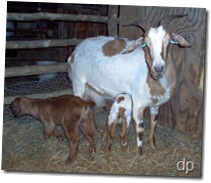
IM000335Until last summer, we had goats. The goats were good for milk and sometimes for meat, although t hey seem to take a lot to grow them to an acceptable size for meat. We had three or four goats that we milked during the last four years, none of them being anything more than average milkers. When comparing the time spent taking care of them and milking them compared to what we were getting out of it, it just didn’t make sense to keep raising them. We bought a cow and were getting milk from her, so we sold the goats last summer.


091 Our cow is a full Guernsey we named Josephine, but we usually call her Josey. She had a bull calf last May, which is now a steer, who we named Chucky Joe. He’s staying at a friend’s place right now, simplifying weaning. Josey provides us with about 2.5 gallons of milk each day. We only keep about a gallon of it each day for ourselves, giving the rest to my parents and to Danny for his mom. Chucky is slated to be converted into beef next winter. We grow all of the hay needed to feed Josey and Chucky and my Dad’s goats. We also have enough to feed our goats, if we still had some.

002a Most of the red meat we eat during the year is venison. Besides the deer I, Dad, and Danny are able to harvest, people in the neighborhood generally give us several. We process them all ourselves and preserve them, usually by freezing and canning. This year I tried drying some. I also cured some in a salt brine and then cold smoked it in a homemade smoker. We’ve only eaten one of the smoked roasts so far, and it was quite good.

What food we aren’t able to grow or harvest ourselves, we buy, mostly through the local food co-op. We order from the co-op every four weeks. Right now, that’s where most of our grains are purchased. What we do buy, we endeavor to buy certified organic. That doesn’t guarantee its wholesomeness, but it is generally a lot better than conventional.

I’ll write about more or our homesteading objectives in subsequent posts.

Thursday, December 25, 2008

Early morning frost, birds, & a skunk

It was a beautiful morning. A clear sky with a bright sun rising above the horizon. I was a little late setting out to do my chores, but the beauty of the beginning day prompted me to take my camera with me in the hopes of capturing some good shots.frost on fox tailfrosty grass with sun


There was a heavy frost on everything in the bottom, the result of moist air and below-freezing temperatures. When you view a frosted blade of grass closely, you discover that the frost is made up of very small ice crystals. These crystals catch the light of the sun and sparkle.

frost on grass ice crystals -- frostIt was fun trying to capture the beauty of the morning and the little intricacies that exist all around us. I’m still learning how to do it well, but it’s a fun process. 

The birds were happily flitting about this morning, too. We have a variety of different types around here. pileated woodpeckerMany times when I’ve been out early of a morning during hunting season, I’ve noticed that they all seem to wake up about the bird on branchsame time. With the 10x optical zoom on my camera and the 5x digital zoom, I was able to get close enough to snap some bird photos. One of them was a pileated woodpecker. They make a lot of noise as they fly from tree to tree. They’re good-sized birds.

Later in the morning after breakfast, Danny came over and asked if I would look at something. He said it was an animal he caught in a trap, and he wanted to know what it was. He said it was black with a white spot on its head. I thought skunk. That’s what it was. We let it go, successfully avoiding being sprayed. The little guy didn’t seem too concerned about us and gladly trotted away.

skunk
[I used Windows Live Writer to compose this blog post. This is a new tool for me – I just downloaded it today. It handles photos quite well, but there are some quirks in text editing which I hope to figure out as I use it more.]

Monday, December 22, 2008

Keeping warm during winter

The winters we've experienced here in Kentucky have been quite mild in comparison to some I remember on the plains of Central Illinois. However, that doesn't mean it doesn't get cold here. In fact, the temperature dropped to about 5 degrees last night. It was only in the low 20s today, but we're expecting a high of about 58 degrees on Wednesday.

Our vision of homesteading guides our adventures and endeavors. We want to provide for as many of our needs as we can, limiting our dependence on other systems and service providers. One area in which we have limited our dependence is for heat in our home when it gets cold outside. We heat with wood. To completely restrict our dependence on outside resources, I'd have to cut all of our firewood without the aid of my chainsaw. That could be done, but since it's not necessary at this point, I have not made the move to do without my Stihl MS250. Part or our intent is to be prepared for a time when services and conveniences may not be available. So, we still have utility bills and appreciate "modern conveniences."

To provide heat, we purchased an Amish-built, dual-purpose heating and cooking stove three years ago. It's a Bakers' Choice. We really like it. Previously, we used a wood heating stove that was in the garage when we moved here. There was already an insulated chimney installed through the roof in the mobile home. Yeah, most regulations say you're not supposed to have a wood stove in a mobile home, but for various reasons, I'm not concerned about those regulations. We are safe and responsible, and I'm enough of a Libertarian to believe that what I choose to do is none of the government's or anyone else's business.

I installed a new double-wall, insulated chimney when we bought our new stove. It has a 7" diameter rather than the usual 6". That's what the stove is made for, and the old 6" that was here previously needed to be replaced anyway.

Our heating needs so far have required only about 3 cords of wood each year. It doesn't take too long to cut that amount of wood, especially if it is easy to get to. By that, I mean if it doesn't require too much carrying up steep hillsides in order to get it out of the gully in which it lies. Most of what we've burned so far has been cut on other people's property. Why cut my own trees when others have dead trees or tops left from logging readily available? One neighbor friend is allowing us to cut up the tops from trees on the 40 acres he had logged. There is years' worth of wood in there, and we can drive right up to most of it. Dad, Danny, and I can several cords of wood in a day.

Today, the sun was shining, and it was quite a beautiful day. The temperature was only in the low 20s, though. I had some logs laying on the neighbors property across the fence from our home that Dad and I had drug up out of the gully this fall. We drug it with the tractor using several chains. These logs were from a couple of trees that had blown over early this summer. One was a cherry tree with three trunks ranging in diameter at the but end from 10 inches to 14 inches. The other was a maple tree that had blown over. It was much bigger, close to 24 inches in diameter. So, I decided to cut these logs into firewood today.

I cut them into 16 inch lengths, on average, a size that fits nicely in our stove. Most of these pieces needed splitting. So, after running one tank of gas through the saw, I began splitting them into the proper sizes. Dad showed up after a while with his splitting maul and helped split. He said he needed some exercise since he'd not been doing much because of all the rain we've been having. So, we split what I'd cut. Then, after lunch, I cut the rest of the logs into lengths, and Dad and I split them all into firewood.

After finishing all of the splitting, we loaded the wood on my 16 foot trailer. It's actually still on the trailer, because by the time we finished it was time to begin my chores. There ended up being a fairly nice load of wood out of the logs. I saved four small cherry logs (about 6 feet long) and one maple log to mill into lumber. I want to have cherry runners and maple risers for the stairway in our new house. I'll unload the trailer tomorrow, I expect. Tomorrow, Dad and I are planning to begin cutting up a big, old white oak that we drug out of another gully this fall. There will be two or three times as much wood out of it.

Prior to heading down the hill to do my chores, I snapped a few photos of the sunset. There was a bit of nice color. This one turned out nice. So, I thought I'd share.

Monday, December 15, 2008

The cast of characters

Since I'm going to be talking about my family in many of my blog posts, I thought it would be expedient to introduce everyone that lives here.

My wife, Anne, and I have been married for over eighteen years. She's a great blessing in my life for which I am very thankful. God has blessed us with four wonderful children. They have all been born at home, the last two here on the homestead. Jessica will be 12 in January. She loves horses and has a great interest in drawing. She has quite a few drawing books she spends time with working on her drawing skills. She also loves to read. She does a lot to help with the jobs and chores around the house and in the garden. I hope to acquire a horse for her benefit sometime within the next two years. I think it would be good for her. She has ridden Josey, our cow, but only when I was leading Josey. Besides, that's not quite the same.

Our middle children are our boys. The older is Ramiah. He's 7-1/2 years old. He has a lot of creative ideas and loves machinery and tools. He loves to build things when he has the opportunity. Malchiah is our third child. He just turned five in November. He is energetic, generous, and loves to have fun. He's been my helper since he was just a little guy, and he still loves to be with me doing chores or when I'm out working. If the work involves using a tractor or other machinery, Ramiah also clamors to be with me. It's really something watching these boys grow into young men. I pray that I can guide them as they need.

Our youngest is Naomi Shalom. She'll be three in March. She's a curly-headed little darling, cute as can be and knows it. She's almost always happy and spoils me rotten. She too wants to go do chores with daddy. If she doesn't get to go she is mightily disappointed. She loves to help around the house.

Anne, my beautiful wife, does so much to keep us going. She takes good care of me and our children. She oversees most of the food preservation. In fact, she canned nearly a thousand quarts of food this last summer and fall. In previous years we froze a lot of the food we harvested, but this year we tried canning most of it. Next year we intend to dry as much as possible. She's also the one who does the bulk of the homeschooling of our children. She does so much, and I appreciate her greatly. She has quite a knack at finding good deals at thrift shops and on Ebay.

I'm Darryl. I do a lot of different things around here. I take care of the animals, which right now consists of a cow and her calf and half a dozen turkeys. We have had goats and chickens until this last summer, and we'll probably have more again in another year or so. I'm building our house, a timber frame with strawbale walls. You can read about that project in my other blog, Cedar Ridge Farm. I mow, rake, and bale our own hay and cut firewood among other things. My income generating job is teaching an online class for Illinois State University. It doesn't produce much income, but it is enough to pay bills and allow me to be at home to do my real job. I'm blessed with this opportunity because of the 26 years I spent in school from Kindergarten through my Ph.D.
My parents, Garry and Connie, live about 200 feet from our house on the farm. When we bought the property, there was an unfinished, one-bedroom cabin the previous own had started. It was enclosed and had electricity, but that was about it. We mentioned to my parents that this was for them, and dad grabbed ahold of that idea like a bulldog on a bone. They moved down here from Illinois the spring after we moved, rented a house in town, and remodeled and finished their house. It's a blessing having them here. Dad helps me with many different jobs that I need help with with, like baling hay and working on our house. You can probably read about some of them on his blog. I help him as I can, too. Mom does her best to spoil our children, and they encourage her in that endeavor, I'm afraid.

A friend of mine from college, Danny D. Smith, also lives here. Danny and I met and became friends in 1987 when we both worked in the kitchen at Ambassador College in Pasadena, California. We kept in contact after we both graduated. After we moved here, he sold his home in the Raleigh, NC, area and moved her in the spring of 2004. He bought a small double-wide mobile home and put it across the driveway from our home. He takes care of his mom who lives with him. Our children love Uncle Danny. You'll often find one of the boys or Naomi (or all three) with him, using his tools or trying to "help" him. He enjoys our children and is very generous with them.

  © Blogger template 'Minimalist G' by Ourblogtemplates.com 2008

Back to TOP