Showing posts with label garden. Show all posts

Tuesday, October 11, 2011

My first Back to Eden garden

Last spring I hauled home 6 dump truck loads of wood chips from the local stock yard. I piled them up after bringing them home and watched them steam on cool mornings. I mulched around fruit trees and berry bushes with them, but most of the pile remained unused. Until this week.

After watching the Back to Eden film which details Paul Gautschi’s gardening technique, I was persuaded to give it a try. I had already sowed some fall greens in our main garden, and I didn’t want to disturb them (we’ve been eating some tasty salads for about a week now). One of our smaller garden areas had sweet potatoes in it, but it was time to get them out.

So, after harvesting about 20 bushels of sweet potatoes, and bringing in the basil plants to dry, it was time to create a Back to Eden garden. This particular garden plot is 50 feet by 75 feet.

The first step was to remove what weeds were left and then smooth out the remains of the ridges in which the sweet potatoes were grown. I used the disk to do that, although that wasn’t the only or best option. I wasn’t trying to work the soil up, just level it out a little.

Then, I hauled several truck loads of compost and dumped them on the garden. I used the tractor with a box blade to spread the compost as evenly across the garden as I could. 002It ended up being about one inch to two inches thick.

The next step was to haul wood chips. I hauled 6 or 7 truck loads, leaving about one truck load where the original pile was. Then, it was time to spread the chips across the garden as evenly as I could. I used my Bobcat for some of this, but a lot of the spreading had to be done manually, with a rake, hoe, shovel, and wheel barrow.

It took a couple of hours, but I was able to spread the wood chips across the garden to a depth of about 4 to 6 inches. It looks good, I think. Soon, I hope to plant some garlic and a few potatoes in it.
004

Monday, September 19, 2011

Back to Eden–a must-see gardening film

A friend sent me a link to the teaser for a recent documentary called Back to Eden. It’s about the gardening philosophy and techniques of Paul Gautschi. He said that if I watched the teaser that I would then watch the full video (which is available to be viewed online free). He was right. I’ve watched it twice so far, and it is excellent! It’s inspiring. I will be implementing the methods Paul talks about in the film as I am able, starting right now.

If you already grow your own food/garden or are interested in doing so, this is a must see film. Watch the teaser and see if it doesn’t pique your interest and prompt you to watch the full film.


Now, follow this link to watch the full-length film: www.backtoedenfilm.com/

Let me know what you think.

Saturday, June 18, 2011

Our three gardens

It’s been a few days since I last posted. There’s not been a lack of things to do, and I have still been accomplishing much. Once the rain stopped, we got busy in the garden. We set out 50# of seed potatoes, 32 pounds of onion sets, 150 tomato plants, nearly 300 sweet potato plants, a few cabbage and broccoli plants, and about three dozen eggplants. We’ve also planted peanuts, dried beans, green beans, sweet corn, pop corn, squash, melons, okra, and cucumbers. I’ll be planting some more sweet corn and green beans soon.

We’re using three different garden areas this year, more than we’ve utilized in the past. One has the onions, potatoes, tomatoes, and sweet corn in it at the present time. 025Another has the sweet potatoes and some watermelon. We’ll probably put the next planting of sweet corn in this garden since there is still room for it. The other, and largest, garden has several types of melons, green beans, dried beans, and peanuts in it.

The children have been helping with taking care of the garden. Each year as they grow they are more able to contribute to our food production. 004My boys have really been helpful this year with planting and weeding. I try to not overwhelm them with too much at a time, and they’ve really been doing a good job and with a good attitude.

I think it’s important for children to grow up with responsibilities and learning to work. There are so many things that they can do to contribute to their family, and there are so many valuable things to be learned through the process. Too many children, I’m afraid, are not expected to contribute to their families in meaningful ways. When I was growing up, my family had a very limited income, and our gardens provided a good deal of our food. Each of us was expected and required to participate in the growing, maintenance, harvesting, and preserving of food. I didn’t always appreciate it at the time, but I certainly do now.

One of the challenges we’ve faced with the gardens during the last couple of weeks is the deer. They decided that we’re growing food for them. They’ve eaten on our peas, beans, beets, chard, and lettuce. 037They basically destroyed the beets and chard – I guess they tasted good to them. After they’d eaten on the beans which were just starting to blossom, I put up some deer deterrent: baling twine. I’ve been told that deer don’t like the smell of baling twine, and three years ago we put up a fence of it around our garden because of the deer, and it kept them out of it.

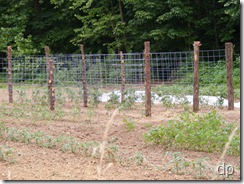
After I fenced off the beans with baling twine, the deer decided to eat some of the younger beans. These deer appear to be very hungry based upon how they’ve been eating. 032So, the boys and I put up a perimeter fence around the bean garden using 10’ poles driven into the ground and four strands of baling twine. We also tied rectangles of aluminum flashing onto each pole to move with the wind and create noise. So far, the deer haven’t been back in the garden, but it’s only been a couple of days. I’m hopeful it will keep them out for most of the growing season.

Yesterday, Malchiah and I worked on getting some of our tomatoes staked up. Last year I used livestock panels in an A-frame configuration – two panels on either side of the row tied together at the top. 015This year my rows are 30 feet long which requires four panels per row. I have 12 panels and didn’t want to spend the money to buy more. So, to be able to cover more rows (we have 8 rows of tomatoes), I changed the method for this year.
We started with three rows yesterday. I set some cedar posts at the ends of the rows and one post in the middle of each row. Then, we hung two panels between the posts right above the tomato plants. The panels are about 9 inches off the ground. I tied the larger plants to the bottom of the panels and wove their branches them. As the plants grow, we’ll weave them through the panels to the top, or as tall as the plants grow. We’ll tie them to the panels as necessary. It takes more work to set posts in the ground, but this way we have enough panels for six rows. 020I’ll stake up the other two rows differently.

We’ve been enjoying fresh blueberries and black raspberries this week. Soon, it’ll be time to pick blackberries. We usually pick and preserve as many blackberries as we can. Last year we picked around 20 gallons. We’re planning on doing the same this year.

I’ve been teaching two sections of my class this summer. There’s one more week to go in the session. It’s been taking a lot of time, but it’s worth it. My objective is to encourage the students to question the institution of school by considering some of its harmful effects and how it is not designed to promote learning/education as they assume. As one of the authors they read says, “School makes children stupid.” I enjoy the class, but it’ll be nice to be able to focus and devote my time to projects (like finishing our house) here on the farm.

Friday, April 8, 2011

Cows on grass and gardening

We moved the cows out of the barn and back onto grass this week. They seem happy, and our milk production has gone up. 025I’ve provided them with some hay to make sure they have enough roughage as they transition back onto green stuff, and they are doing well.

After I moved the cows out, I started cleaning out the barn. They were in the barn for four months. I used straw and saw dust for bedding while they were there, giving them fresh bedding every day and letting it accumulate during the entire four months. 028Two full grown cows and two young steers can make a lot of manure mixed with bedding in four months time.

I used the Bobcat to start cleaning it out. The way the barn is set up, I can only get the Bobcat straight in from outside and clean a pathway across the cows’ area inside. There isn’t room to turn and clean out the rest mechanically. We’ll have to clean out the other 80% by hand, or at least loosen it and throw it into the middle so it can be moved out with the Bobcat. We’ll complete this work over the next couple of weeks, I hope.

On other blogs, I’ve read about people starting their garden plants inside over the last couple of months, 015but I didn’t get any of starts going until yesterday. I have no place inside our current home for starting seeds. In the past I’ve started seeds in the basement of a previous home under grow lights or in a greenhouse. I don’t want to use the power to keep a grow light on with our electrical system now even if I had the space/place inside for it.

Without a place for starting seeds and with the length of our growing season, I’ve not worried about having not started my seeds yet. So, yesterday, 014I mixed together some growing medium (one part compost, one part peat moss, and one part rich dirt) and planted some seeds: tomatoes, peppers, and eggplant. I put them in some flats I had from last year and set them under a makeshift greenhouse.

The makeshift greenhouse is a metal framework with plastic stretched over it. When I checked it a couple of times today, it was nice and warm and moist inside. I think with the warm weather we’re having, the seeds should sprout fairly quickly. I don’t plan on setting plants out until mid-May. So, if all goes well, they should be ready by then.

Then, today, the boys and I planted some things in the garden. First, I worked up an area about 30 feet by 30 feet. 020Using my grape hoe (an wonderful tool), I pulled dirt into four ridges. I filled the trenches left from pulling the dirt together into ridges with wood chips about 6 inches or so deep. This makes nice walkways with material that will break down over time, feeding the worms and adding to the soil. Then, I smoothed the tops of the ridges with a rake, making rows about 18 to 20 inches wide for planting.

This afternoon, we planted several varieties of lettuce, spinach, beets, swiss chard, and carrots in these wide rows. 023We also planted several rows of sugar snap peas in another area right beside the first one. We’ll be planting a lot more things in the coming weeks.

I had an interesting experience while using the Bobcat to the wood chips from the big pile to the garden: a wheel fell off. Apparently, the lug bolts had come loose, they worked themselves out. I hadn’t noticed this was happening. As I made a turn to head into the garden, the wheel fell off, and the Bobcat sat down on its haunches. I found three of the bolts and borrowed one from each of the other wheels to reattach it before continuing with the work.

After finishing the planting, the children and I went for a swim in the pond. It was a bit cool, but we all enjoyed it.

Wednesday, March 23, 2011

Spreading more compost

It didn’t rain last night (there was a chance). So, this morning, I spread compost on the small field near the orchard, at the end of which I planted the 50 asparagus crowns earlier. My compost spreading process involves two tractors, 003a manure spreader, a loader, and a field cultivator.

This is the field before I started. I disked it a few days ago. Last year, we tried to grow corn here, but the crows and other varmints interfered with that. The soil doesn’t have a lot of humus, appearing to be mostly clay. Like much of the other ground on our farm, it was used to grow tobacco in the past. There were tobacco stalks in it when we moved here almost eight years ago.

I took compost from the piles at then end of the field. Yesterday, 005I used from one of the piles for spreading on the garden.

The manure spreader that I have is an old one that I bought last spring. Of course, it’s not as old as the one I used before I got this one. I’ve only been able to use this one the last couple of days even though I bought it a year ago. Thankfully, it worked fine today. I pulled and powered it with my 1966 International 424. 008This has been a very good tractor since I bought it 7.5 years ago. I use it for just about everything.

Part way through the process, I took a photo of my progress. I’d already spread 10 loads at this time, and the first pile was completely removed and I had started on the second pile. I loaded the spreader with the loader tractor. 011I would’ve liked to have used the Bobcat, but it needs the battery charged. The voltage regulator doesn’t work on it. I ordered another one. Hopefully, that will keep the battery charged.

In all, I spread 13 loads on the field. I estimate each load at around 3,000 pounds. Since the spreader is PTO powered, I ran the tractor in first gear to allow the compost to be spread as thickly as possible. I also went over the same ground at least twice. It’s amazing how little it looks like when it is no longer piled up.

Once I finished spreading, it was time to rip the compost into the soil. I didn’t want to leave it on the surface to dry out and lose some of its goodness. 013Thankfully, most of the time while I was working it was also overcast.

The field cultivator I used has seven shanks and does a really nice job. This ground was a little harder than the garden I worked yesterday. So, I couldn’t get it to go in quite as deep. Almost as deep though.

It started to rain a little just as I finished working the compost into the ground. I considered that a blessing. It wasn’t much rain, but it was nice to have a little to wet the compost into the ground a bit.

The final photo is of the field after I finished. The soil doesn’t look much darker than before in the photo, but it is a little. It will take several years of working in compost to get it where I would like it to be.

016

We’ll use this field as a second garden area. I don’t know that we’ll use all of it this year. What we don’t, I hope to sow buckwheat or some other beneficial cover crop on.

Tuesday, March 22, 2011

Warm and dry in March

Last post I mentioned how we usually warm up and dry out in March. It happened again. We’ve been experiencing summer-like weather for the last few days, and it’s been keeping me busy.

On Sunday I had 50 asparagus crowns to put in the ground. I put lots of compost into the trenches I had already dug and set the asparagus crowns in it. I was able to get them all bedded, and hopefully they’ll be happy.

I also plowed an area for our field corn. It’s not a very big field, but hopefully we can grow enough for corn bread. Last year the crows ate the seed out of the ground and then the raccoons and deer tried to demolish what the crows missed. Hopefully, we’ll do better this year. I’m going to spread a good bit of compost on the soil before it’s time to plant since this particular plot has some poor soil. I actually plowed it a few years ago but didn’t plant anything in it. So, it’s had a bit of a break. I think it previously had tobacco planted in it, as just about every field here has.

Yesterday, I planted the nine cherry bushes that were anxiously waiting to be set in dirt. I put two in front of the house so that we can enjoy their blossoms in the spring. The other seven I set out in a row near the new asparagus rows – they’re on the edge of the orchard. I used the 12” auger on the tractor to dig the holes which was much easier than using a shovel. I dug them deep and put lots of compost in the holes before planting.

Yesterday afternoon I spent working on the manure spreader. I bought the spreader last spring, and the first time I went to use it, the apron chain broke (that’s what walks the material to the back of the spreader). I’ve been needing to fix it, and it’s been waiting patiently. In anticipation of spreading some compost on the gardens, I decided it was time to get it done. I took the chain out, replaced the floor with some new beech boards I had (it had a plywood floor with a few holes).

After buying the necessary hardware and links for the chain, I bolted the floor boards in, repaired the chain, and put it back in. I wasn’t able to try it out until this morning. It seemed to work fine, though. However, on the second load, another link in the chain broke. So, I had to shovel everything out. It occurred to me that at that point, I had shoveled more stuff out of the010 spreader than it had actually spread for me. I replaced the broken link and made a few adjustments, and then it worked fine.

I spread the pile of manure and bedding we cleaned out of the barn last fall – that was the accumulation from the winter before. Most of that I spread with the loader tractor and a grader blade after the manure spreader broke. I used a friend’s field cultivator to rip the material into the dirt and work up the ground. Then, I spread several more loads of compost from another pile on the garden and ripped it in.

I’ve got another garden area to spread compost on and to work up. If we don’t get much of the rain that’s possible tomorrow, I’ll see about doing that later this week.

013

Friday, March 18, 2011

Putting plants in the ground

It felt a lot like summer today. Our high was about 80 degrees. We had rain a couple of days ago, but the warmer temperatures and breeze that has been blowing is beginning to dry things out. Usually, there are a couple of weeks in March/April that it dries up enough to work the garden and begin getting some things planted. It’s till too wet to work up our main garden area, but maybe we’re getting closer to that drying period.

001I did work in the dirt a bit yesterday and today. A couple of months ago, I ordered some plants. They arrived this week. So, I thought it would be a good idea to get them in the ground.

Yesterday, I planted three Rosa Rugosa plants that Anne ordered free from Gurneys. I planted some in front of the house we lived in before we moved to Kentucky, and we enjoyed them. One of the reasons for getting them now (besides the fact that they were free with the Gurneys’ promotional coupon) is that Rosa Rugosa produce many nice-sized rose hips. We want to harvest them for tea.

009Also yesterday, I put six hazelnut trees in the ground. We would like a good nut source. The wild nuts around here are hickory and black walnut. Primarily, we’ve used hickory nuts.

I’ve been digging into one of my compost piles, the smallest one actually, for these plantings. Today, I dug into it a bit more for the strawberry beds. I finished my work on the Bobcat earlier in the week and was able to use it for moving the compost. 005About three years ago I framed two beds about four feet by 50 feet using some cedar boards and slabs. I added some compost to them and planted strawberries.

We had a few strawberries the next summer, but the deer and weeds were hard on them. Few actually survived. So, yesterday, the boys pulled out all of the old weeds from the beds to get them ready for today. This morning, they dug out the few remaining plants, and I filled the beds with compost. I would say the layer of compost was 6 to 8 inches deep. We then used grub hoes and then the tiller to work it into the soil in the beds a little.

Once the beds were ready, we planted the 100 strawberry plants that arrived two days ago. We also replanted the ones that survived from the previous planting. Later, after they are established, we’ll mulch the plants well to help keep down the weeds. 011I think weeds are the greatest problem with growing strawberries.

We still have 50 asparagus crowns to put in the ground and some cherry bushes, too. This afternoon, I disked the area where we tried to grow corn last year. At one end of it, I used the turning plow to dig two ditches. 014On Sunday, we’ll put compost in the ditches and plant the asparagus in them. We’ll also put the cherry bushes in the same area – it’s actually on one side of our small orchard which seems like a good place.

Later, I’ll put compost on the ground I disked today. We’ll use it for garden along with the main area in front of the new house which will also receive as much compost as I can spread on it. I can see already that I won’t have enough compost and that I need to haul in a lot more stuff.

We’re enjoying the spring weather, for sure. Next week, we ought to be able to get the cows out of the barn and back on grass. They’ll appreciate that, I’m sure. It’s really nice to see things greening up and the early spring flowers. One of our plum trees just bloomed today. There will be a lot more blooms on other trees soon.

019

Wednesday, February 9, 2011

Root cellar and garden/storage crates

If you didn’t know, we’re building a house. I don’t mean that we’re paying someone to build a house for us. We’re building it. Well, I’m doing most of the work, but I accept help from friends and family.

Anyway, one of the things we designed into our home (and, yes, we designed the house ourselves) is a root cellar. At one point in the process, I was going to build a root cellar separate from the house using the methods described by Mike Oehler in The $50 & Up Underground House Book. I still like his method (years ago after reading the book, we thought about building an underground house like he describes), and may use it for some structure sometime in the future. If you want to build a fairly inexpensive root cellar, you ought to check out this method.

We changed our plans for the house more than once (it’s been a developmental process, and it’s only gotten better with each change we’ve made to our plans). One of those changes was to make the root cellar under part of the house with access to it from the house. 024So, I dug a hole with the use of a friend’s backhoe and constructed a root cellar. You can read about how I built it here.

We haven’t gotten to use the root cellar yet, though. We haven’t gotten to live in our house yet either, but we’re getting closer all the time. 031In fact, just this week I built the stairs to the root cellar. 

The root cellar has two rooms, a larger one and a smaller one. The larger one is about 8’x13’. The smaller one is about 8’x 8’. I still have to insulate in the ceiling and install the exhaust vents in each room. Then, there will be 026shelves and bins to build, but I’m looking forward to being able to store some food in it next fall and winter. Hopefully, if all goes well, we’ll also be living in our new house by then.

Earlier this week, I bought some storage crates to use in the garden and root cellar. 025I saw them advertised on Craigslist late last week. They are really very nice. They measure 24” x 16” by 8.25”, and if filled up to the handles, they hold one bushel (based upon my calculations of volume). They are very sturdy and stack nicely. I think they will be very handy. You can buy them new from a few places, but they’re expensive. I’m glad to say I paid well less than retail price for them.

I move them into the root cellar yesterday after I finished the steps. So, they are now waiting for the coming harvest season and the christening of our new root cellar. In the meantime, we have more snow (it won’t last long, though).

040

Thursday, October 14, 2010

Peanuts and peppers


Last spring I planted peanuts in two different locations. In the first patch, I made ridges to plant them in, and they grew very well. The boys mulched the after the plants got going well. The other patch, however, was decimated by crows. peanuts in the summer kitchenThey picked the seed out of the ground soon after it was planted. Granted, they did leave one or two peanuts that sprouted and grew only to be choked out by the weeds later on.

I dug on row of the peanuts that grew well last week, and the boys dug the other five rows earlier this week. The plants produced well. It was interesting to pull up the plants and find where they had rooted from the vines through the mulch and set on peanuts there as well as at the base of the plants.

We fed the vines to the cows who absolutely love them. The boys spread out the vines from their digging so that they could dry, and I feed some of these to the cows when milking. Both Josie and Tilly are eager to eat this treat at milking time.

After picking the peanuts off of the vines, we spread them out on a couple of window screens to dry outside for a few days. We moved them inside the summer kitchen when we got a little rain. It’s a pretty sight to have screens of peanuts spread out. The peanuts also taste really good. I don’t care for raw peanuts generally, but these are good raw. They’re also good sautéed in a little butter or roasted in the oven.

I also built a frame from which Anne can hang sweet peppers above the wood stove to dry them. I set out a lot of pepper plants in hopes of having a lot to dry. However, the plants didn’t bloom or set on many peppers until September. I’ve had that happen before – really nice plants that don’t produce until the end of the season.

Anne cuts the peppers into rings, runs a string through them, and hangs them up to dry. When they are completely dry, she stores them in jars. They are a nice addition to chili, meatloaf, and other dishes. The children also enjoy just eating them.

Thursday, October 7, 2010

Sweet potato harvest 2010

Sweet potatoes

On Tuesday, the boys and I dug our sweet potatoes. We had frost down in the bottom two mornings this week which didn’t hurt anything. A few of the leaves on the sweet potato vines were touched, but I don’t believe the notion that frost will go down the vines into the potatoes as some claim. I an inclined to believe that sweet potatoes can’t stand cool temperatures, and that if they are allowed to chill below 45 degrees they won’t keep well.

Anyhow, it was time to get them out of the ground and into the house. We planted somewhere in the neighborhood of 300 slips last spring. Sweet potatoes are easy to grow, and we’ve had very good success with their production. The harvest in the bed of the truckWe plant the slips in ridges, mulch them a few weeks later when they’ve gotten going well, and then leave them alone other than pulling a few weeds. The only other chore for the season is digging them out of the ground.

I estimate that we harvested 10 bushels of sweet potatoes this year, approximately 600 pounds of these nutrient-rich little buggers. We sorted out the best ones based upon size and blemishes, In the cratesfilling 7.5 crates which I stacked inside. I made these crates a few years ago, and each one holds about 1.25 bushels. There was about 2 bushels that we sorted out to use first, the ones with scrapes, vole bites, blemishes, etc. So, there may be more than 10 bushels, but that’s okay.

We’ll eat from this harvest all winter and through the spring, assuming they cure and keep well. sweet potatoesGenerally, sweet potatoes keep very well for us. They are currently stacked in the children’s room, where they will stay for the duration. After they’ve cured for a couple of weeks, we’ll cover them so that they won’t have light shining on them which could encourage a few of them to sprout prematurely. Next spring, we’ll start slips from some of them for next year’s crop.

Friday, June 25, 2010

Compost, garden, and blackberries

I hauled two loads of composting material from the sale barn yesterday. It looks like some nice stuff. I dumped it behind the ridge at the end of the pile two loadsI built back there a few months ago. pushed into a pileUsing the loader tractor, I was able to push it all up together. Now, we’ll let our little bacterial friends do their work, turning the material into black gold, ready to enrich the soil and grow awesome gardens next year!


The original pile I built behind the ridge has shrunk in size quite a bit during the few months it’s been there. We planted some watermelon at its base a few weeks ago which are coming along fine. butternut winter squashWe planted some butternut squash at the base of another small pile. It’s looking happy.


corn fieldI thought I’d share a photo of our poor stand of field corn. We were able to hoe a lot of the weeds and grass out of it last week. I still ought to run the tiller between the rows to get rid of a few more weeds and grass. I hope to be able to get at least enough corn out of it for next year’s seed. I hope the crows aren’t a problem again.

freshly picked blackberriesBefore lunch yesterday, I went out to pick some blackberries. It’s that time of year. With all of the hot weather and lack of rain, it looks like the berries are going to ripen within a short period of time. My dad has been out a few times to pick berries, and he came along and picked with me and gave us the berries! He’s kind like that. Anne canned nine quarts of blackberries after we brought them in.

 jars of blackberries

Friday, June 18, 2010

The work of summer

There’s an amazing amount of work to be done every day. We keep plugging away. I’ve been devoting a lot of time to our house project. We’re making some good progress. You can check it out on my other blog, if you haven’t already.


swimming in the pondThe children and I have enjoyed swimming in the pond several times. They actually ask me if they can go in the pond nearly every day. Usually, there is no real reason not to. The pond isn’t holding water as I would like it to. Water seeps out in several places around the dam. I don’t know if this is something that will correct itself over time as the dam settles more, or not. It’s not a fast leak, but the water level has gone down a fair bit.

We’ve been enjoying some produce from the garden. I didn’t get in a hurry to get the garden planted this spring, so we’re not enjoying things like tomatoes and squash yet. But, those things won’t be too long. We’ve had some nice salads, and the sugar snap peas were awesome! We had new potatoes with our first picking of snap peas a couple of weeks ago. The asparagus did quite well this year, especially considering the small size of our asparagus bed. I think I need to set out about a 1,000 plants!

We’ve been eating fresh black raspberries for the last two weeks. We’re also getting blueberries off of our older plants. Soon, it will be time to begin picking blackberries. Some of the early ones are ripening.

tomatoesYesterday, we got the tomatoes staked up. I like to keep them mulched and hold them up off of the ground. I used to let our Roma tomatoes sprawl out, but now I stake them up, too. They are so much nicer to pick and do better this way.

I drove small posts in the ground and strung baling twine I took off of bales last winter between the posts to hold up the Romas. I’m trying a new method for the Mortgage Lifters: using livestock panels in an A-frame. I learned about this method from another individual who regularly uses it. It is certainly a quicker, easier way to stake up tomatoes.

pole beansWe’re growing pole beans this year. Usually, I plant bush beans. I built a frame work using sycamore poles for the beans to climb on. I may add a few more poles. I have one more row to take care of. I’m thinking I’ll use the livestock panels that we had for the peas. I’m going to save the rest of the peas for next year’s seed. So, they are about done with the panels.

mulched peppers and sweet potatoesThe boys have been working on mulching the plants in the garden. They mulched the potatoes, tomatoes, peppers, peanuts, sweet potatoes, and squash so far. There are still some more sweet potatoes and tomatoes to mulch. Maybe this next week.

The children, dad, and I spent some time in our small corn field this week. The crows about ruined our corn crop by eating the corn out of the ground before it germinated. I replanted between what came up the first time that the crows didn’t get, but the stupid birds ate most of that, too. I don’t know how well it will produce, but there is some corn growing in the field. The weeds were threatening to take over, though. I tilled between the rows, and then we all worked in the rows with hoes. It was hot and sweaty work, but we got most of it done. I have 4 or 5 rows to do this coming week.

I was able to haul one load of manure and bedding from the sale barn last week. This is a slow time of year for them. Also, since they had to do a thorough cleaning a month or so ago after the flood, there’s been less need for cleaning out. When I can see myself clear to do so, I’m going to start hauling some of the old sawdust from the sawmill.

  © Blogger template 'Minimalist G' by Ourblogtemplates.com 2008

Back to TOP